I always loved boxes for sorting stuff (even if I'm messy, but it's an organized mess) and I'm always trying to have the most portable setup. Most of my tools are powered by Type C with this in mind, but carrying them in a traditional tool box is always tricky and most of the time the box is way bigger than needed.
There are commercially available setups that I like, but they are super expensive (I would sell a kidney to get a full ToughBuilt Stacktech setup with the advanced transporter 🤤).
I have 2 3D printers and I have FreeCAD, so I thought I might be able to make something that would fill my need. I started planning to do my own modular toolbox model, but I quickly gave up because I'm not good enough at 3D modeling. I'm too impatient to have to print the same part 100 times to test it (it can quickly get expensive too 😅).
My needs are:
- stackable
- gridfinity compatible
- can have drawers
- a rolling tray
- different size
- easy to print
- easy to assemble
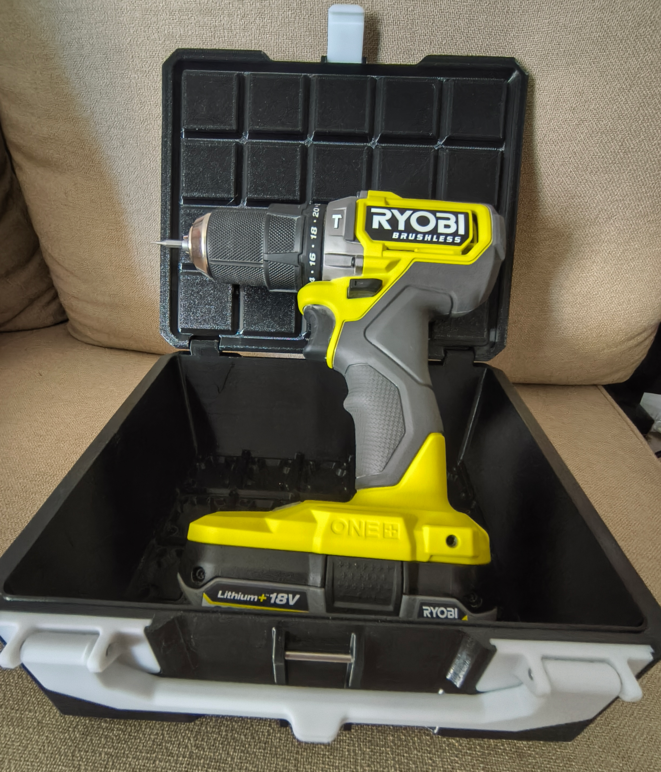
So after several hours doomscrolling on Printables, MakerWorld and every other 3D printing model site, I found a toolbox that met 90% of my criteria, the ShuBox. The only thing I'd change is that, in order to fit my Ryobi cordless drill, I need a 5x5 box (I'd have loved to print the 7x6 but it's too big for my printer 😔), and they are not compatible with the 5x4 ones: they can be stacked, but it's not possible to clip them together (or not currently). Another minor complaint is that it uses pins, but I saw that the maker made a version that replaces the pins with M3 screws that are easier to get — now that I've bought some pins though, I'll use them.
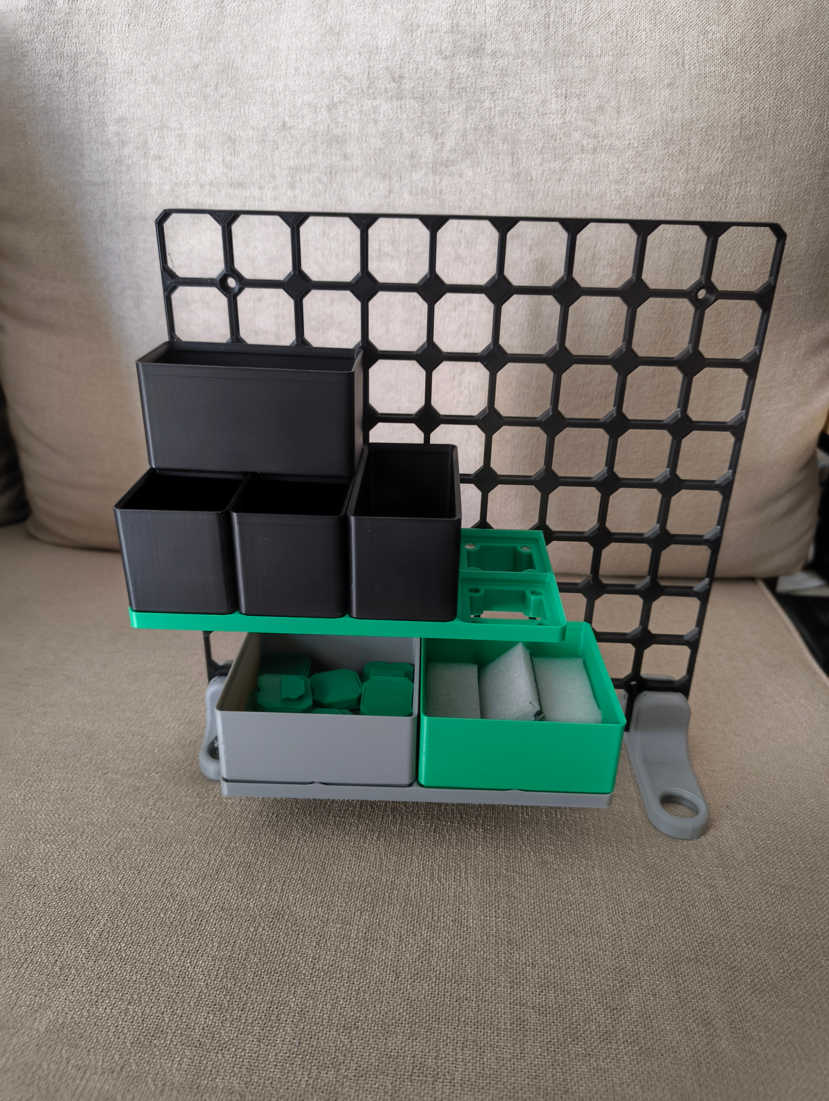
Now that the toolbox is chosen, I need some vertical storage that's gridfinity compatible to replace my cheap (but good) 10€ Lidl unit.
My need was something modular and free-standing since I'm renting and I don't want to make holes in the walls.
First I thought of using printed Skådis boards (an Ikea reference) but after printing 3 little ones I noticed that interconnecting several of them is a pain in the ass if the boards aren't screwed to the wall.
I also saw multiboard, HWS (Honeycomb Wall Storage) and the Cargo Modular System but none of them were open source, or weren't compatible with my needs, or were too complex.
I stayed with openGrid because it ticked every box: it's a wall/desk mounting system fully open source, and it's gridfinity friendly.
Tiles clip together with little pegs (mostly for alignment, but once a few are together they hold each other), and accessories just snap into the holes from the front, so no reaching behind the board once it's up. And it looks clean enough.
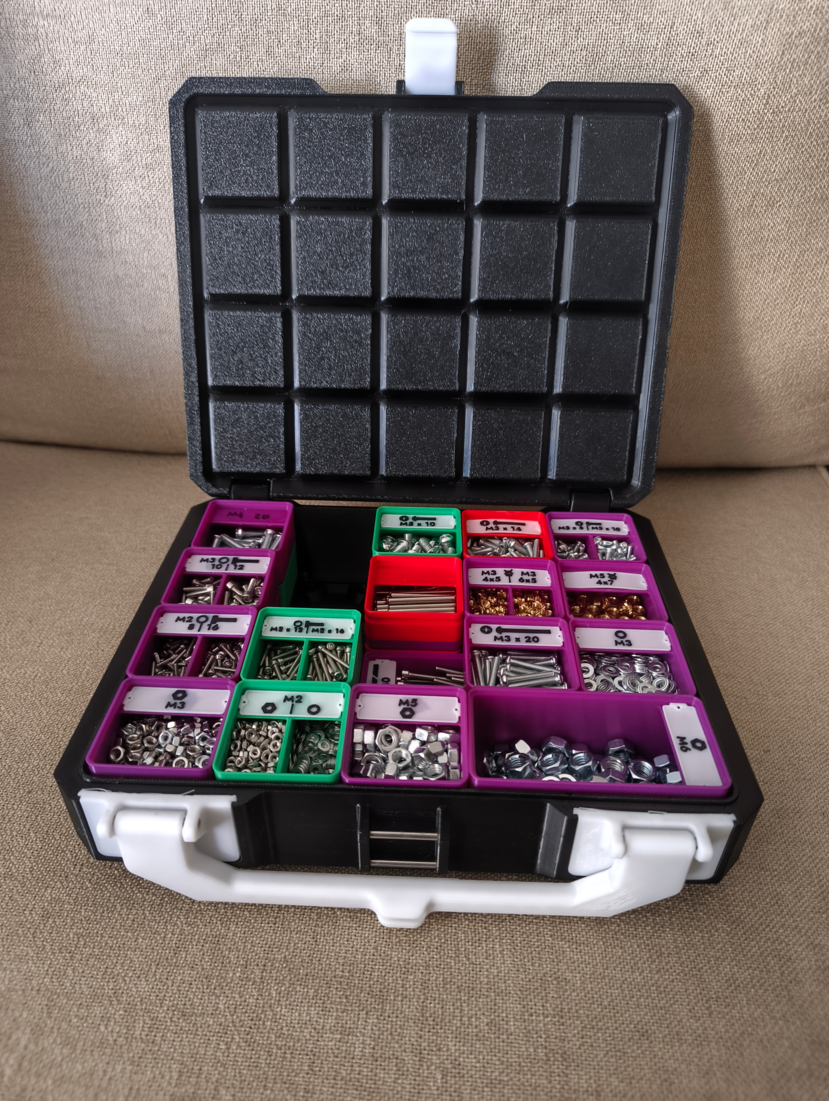
Finally, for the gridfinity bins I've tried many generators and there was always something off, like the height not matching the standard so it wasn't fully compatible with my box. The bins from Gridfinity Generator were good, but then I discovered Pred's Label and my previous bins weren't compatible with it, so I found these bins that are compatible and use less material for the label shelf.
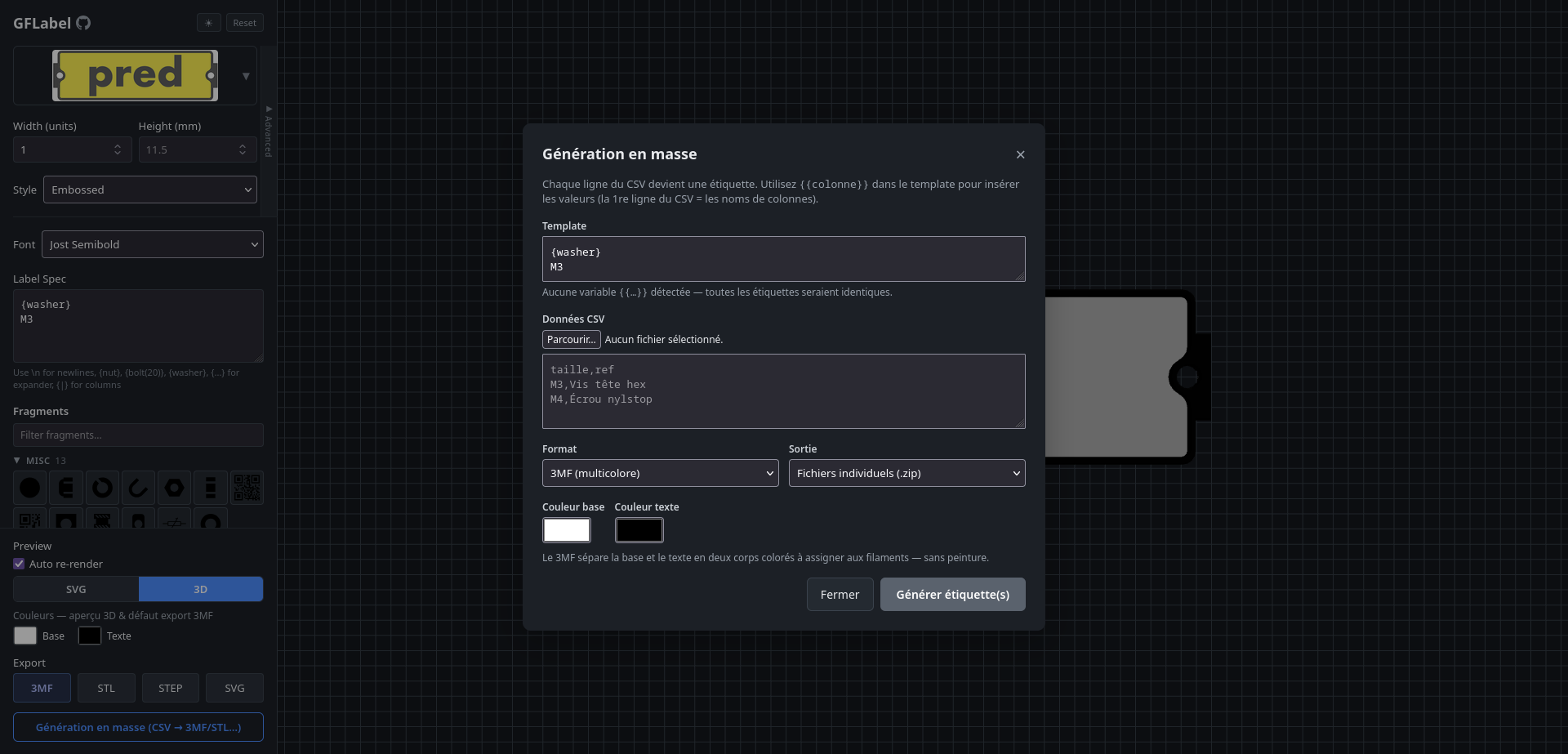
For the labels I found lots of online generators and printable files, but they're always STL and I'm too lazy to add the colors manually... So I found an open source generator, gflabel.org. It's really cool but was still missing the 3mf export to keep the colors in the files. So (A)I added the features I needed in a fork: the 3mf export and the batch export. Along the way I found it was getting slower and slower, so Claude fixed it, and for my comfort I also asked it to add a dark theme.